Thursday, June 5, 2008

Lobok (Loboc) River, Bohol

The Loboc River is the most famous, running from the southeastern coast to the center of the island. It is famous for its River Cruise going up to its water source. The largest, Inabanga River, runs in the northern part of the province.


A fascinating boat ride along the Loboc River has been a major attraction, both foreign and domestic. Starting from Loboc Tourism Complex, Floating Restaurants and motorized boats start the exciting boat ride along palm-fringed banks inland. The Floating restaurants are also the places where fine dining is locate.


Busay Falls is 12 meters wide and four meters deep. It caters to swimmers and sightseers who would be enthralled to communicate with nature.


Tuesday, June 3, 2008

Chocolate Hills, Carmen Bohol

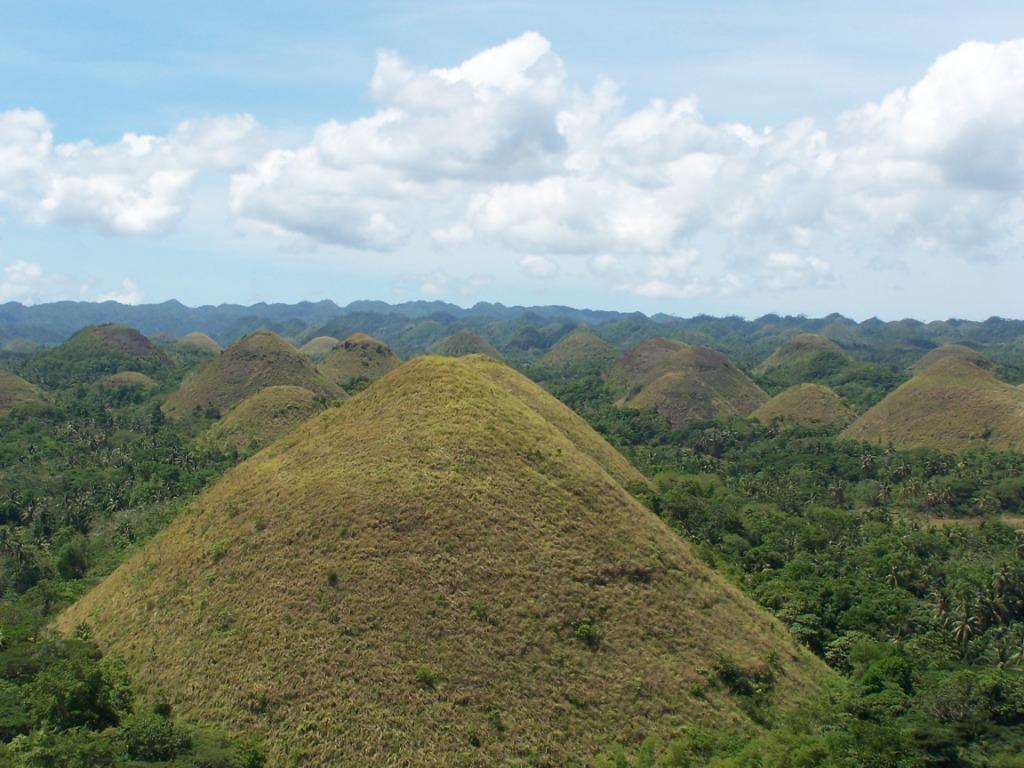
Carmen is popularly known for its world-famous Chocolate Hills specifically located in Barangay Buenos Aires. The Chocolate Hills is considered one of the natural Wonders of the World. Carmen is also where the Fatima Hill is located.


The Chocolate Hills is an unusual geological formation in Bohol, Philippines. It is composed of around 1,268 perfectly cone-shaped hills of about the same size, spread over an area of more than 50 square kilometres (19 sq mi). They are covered in green grass that turns brown during the dry season, hence the name.
The Chocolate Hills is a famous tourist attraction of Bohol. It is featured in the provincial flag and seal to symbolize the abundance of natural attraction in the province. It is in the Philippine Tourism Authority's list of tourist destinations in the Philippines; it has been declared the country's 3rd National Geological Monument and proposed for inclusion in the UNESCO World Heritage List.


Sunday, June 1, 2008

Sagbayan Peak, Bohol


This five-hectare mountaintop resort and recreation center offers massive, spectacular viewing for nature lovers. Its viewing deck offers a 360-degree perspective of the Chocolate Hills plus the blue sea that separates Bohol and Cebu.


The high-powered telescopes on the view deck are a treat. With a 10-peso coin, you can have a view of Cebu City from across the sea for a minute or two. As of March 20, 2005 the management has added attraction to the influx of both local and foreign tourists by bringing the life-size giant dinosaur known as T-rex. It is 19 feet in length and 10 feet in height and is properly situated at the old parking lot near the stairs leading to the pavilion area. Myrna Torrefranca is the operations manager and wife of Mayor Jimmy Torrefranca. They purchased the T-rex all the way from Pampanga by Manila-based business couple Allan and Delia Torrefranca only to give additional attraction to the site even with the existence of another cartoon character like Duffy Duck, Bugs Bunny, Lola, Marilyn Monroe, Donald Duck, Pizza Man, Snow White and 7 Dwarfs, Lion King, Tiger and other dinosaurs.


Sagbayan before, was known as an ambush area. Since Jimmy Torrefrance became chief executive, here the Torrefranca family worked hard if only to change the image of the town into a tourist destination until the Sagbayan Peak was born. -"waypoints" The peak now has a restaurant and a children’s park with Bugs Bunny, Snow White and the Seven Dwarfs, and various other Toontown figures. Aside from the function hall and viewing deck, a hotel, swimming pool, driving range, a butterfly dome and even a tarsier sanctuary are now on the drawing board. In addition a full 100 hectares (1.0 km²/0.39 sq mi) golf course is also planned.


Friday, May 30, 2008

Bohol

Bohol is an island province of the Philippines located in the Central Visayas region. Its capital is Tagbilaran City. It is the 10th largest island in the country, located in the heart of the Visayas. To the west of Bohol is Cebu, to the northeast is the island of Leyte and to the south, across the Bohol Sea is Mindanao.


Bohol is a popular tourist destination with its beaches and resorts. The Chocolate Hills, numerous mounds of limestone formation, is the most popular attraction. The island of Panglao, located just southwest of Tagbilaran City, is home to some of the finest beaches in the country. Boholanos refer to their island homeland as the 'Republic of Bohol' with both conviction and pride. A narrow strait separates the island of Cebu and Bohol and both share a common language, but the Boholanos retain a conscious distinction from the Cebuanos. Hills dominate the island of Bohol. Two ranges run roughly parallel on the northwest and the southeast. An interior plateau is dominated by limestone hills. In Carmen, Batuan and Sagbayan, these hills form near perfect cones in great numbers and are collectively referred to as the Chocolate Hills. Bohol's climate is generally dry, with maximum rainfall between the months of June and October. The interior is cooler than the coast. Geography The Island of Bohol is oval-shaped mainland surrounded with 73 smaller islands, having a gently rolling terrain, ideal for commercial and industrial site development. Bohol's mountainous interior is home to rare and endangered flora and fauna. At certain points, hills drop steeply to the coast from a maximum elevation of 870 meters above sea level. The interior uplands are fit for agro-forestry and high value agricultural production. The central and northern lowlands have also fertile grounds and abundant water supply. Over a hundred caves have been identified, the biggest of which is found in the eastern part which makes Bohol ideal for spelunking adventures.


The Chocolate Hills in Carmen, Bohol are considered one of Philippine's natural wonders and Bohol is often referred to as the Jewel of the Philippines. They are hills made of limestone leftover from coral reefs during the ice age when the island was submerged. They turn brown during the summer, hence their name. Most beaches are of white sand. The sand is often of such high quality that it is exported to other beaches in the world. The most well known of these beaches are in Panglao Island, and there, numerous islets have similar, yet untouched and pristine beaches. The Philippine Tarsier, considered by some to be the smallest primate, is indigenous to the island. The Philippine tarsier, (Tarsius syrichta) is very peculiar small animal. In fact it is one of the smallest known primates, no larger than a adult men's hand. Mostly active at night, it lives on a diet of insects. Folk traditions sometimes has it that tarsiers eat charcoal, but actually they retrieve the insects from (sometimes burned) wood. 


-wikipedia

Saturday, May 24, 2008

Hoyop-Hoyopan Cave, Camalig, Albay

HOYOP-HOYOPAN CAVE A natural tunnel-like structure in Camalig, Albay. Legend says that this cave was the primitive habitat of the natives in the area. It is one of the most popular attractions in Albay. It could be reached by any type of motor vehicles.


Hoyop-Hoyopan Caves - about 15-km from Legazpi, the name means "blow-blow" in the local dialect from the sound of the wind whistling through the main entrance. Archeological artifacts dating from 50 B.C. were excavated by a Franciscan priest and are now housed at the National Museum in Manila and nearby Camalig Church.


Saturday, May 17, 2008

Cagsawa Ruins, Daraga, Albay

CAGSAWA RUINS Originally, the word was Kagsawa. It was derived from Kag, who does or owner and SAWA, meaning a python which suggested one who collects snake or perhaps a snake charmer, On its worst, it signifies excesses from SAWA (pronounced in maragsa on the last syllable) meaning too much. Fr. Francisco Aragonesses, OFM, former curate of Kagsawa and Budyaw, seemed to confirm the notable overindulgence of the people during the time.


Original Cagsawa Church In Daraga, Albay is the famous Cagsawa Ruins, probably the most photographed location in Albay. On February 1, 1814, Mayon Volcano erupted and buried the town of Cagsawa in lava flows. About 1,200 people perished and many of them sought refuge in the town’s church, thinking they would be saved. Now all that remains is the church’s bell tower, the area around which is now developed into a popular tourist spot.


Sunday, May 11, 2008

Mount Mayon, Albay

The PROVINCE OF ALBAY is located between the provinces of Camarines Sur on the north and Sorsogon on the South. It is bounded on the east by the Pacific Ocean, on the northeast by the Lagonoy gulf, and on the west and southwest by the Burias Pass. The island in the north under the jurisdiction of the province are Rapu-rapu, Batan, Cagraray and San Miguel. About 538 kilometers southeast of Manila, the lush province of Albay sands out as the most unique, famed by the province's main attraction, the picture perfect Mayon Volcano, one of the world's magnificent mountains. Her name was derived from the Bikol word "Magayon" which means beautiful. Erupting more than 40 times over the last two centuries, this active volcano towers over the entire Bicol region, rising at 2,462 meters above seal level. An American writer describes her as "an overly perfect backdrop painting of a Hollywood jungle movie." MAYON VOLCANO The world's nearly perfect cone. It stands majestically at 7,946 ft. from the broad base about 10 km. In radius. The crater is 2,451 meters above sea level and with a diameter of .5 kilometer. It has a notched rim where a pool or building hot lava boils and rich coal deposits could be found.


Mayon Volcano is the main landmark of Albay Province, Philippines. It is ten kilometers (6 mi) from the Gulf of Albay, in the municipalities of Legazpi City, Daraga, Camilig, Guinobatan, Ligao City, Tabaco City, Malilipot, and Santo Domingo (clockwise from Legazpi). It rises 2462 m (8,077 ft) above the gulf. Mayon Volcano is the Philippines' most active volcano and is considered to be the world's most perfectly formed volcano[1] for its symmetrical cone. It is a basaltic-andesitic volcano. The upper slopes of the volcano are steep averaging 35-40 degrees and are capped by a small summit crater. Its sides are layers of lava and other volcanic material. Albay also takes pride in other diverse attractions such as clear waterfalls, meandering rivers, spectacular ancient cave network and lush underwater world. 
-wow Bicol Philippines